“Assembled in Germany” – for the highest quality and reliability –

What IT resellers and installers need to know about fire protection, digitalization, and sustainability
The world of network infrastructure has fundamentally changed in recent years. What was once considered mere "accessory" is now a central component of building safety and ecological responsibility. This guide will walk you through the legal foundations and highlight what is important when selling hardware and cables.

1. The Change of the Regulation: From Voluntariness to Obligation
Although the EU Construction Products Regulation (BauPVO / CPR) has existed for over 15 years, copper and fiber optic cables were long exempt from specific requirements. This changed with the ratification of the testing standards in the EU Official Journal (305/2011) in February 2016.
- Entry into force: The regulation for cables officially came into effect on July 1, 2016.
- The transition phase: After a one-year coexistence phase, the grace period ended on July 1, 2017. Since this deadline, all affected products that are permanently installed in buildings must be tested and classified.
2. Technical Innovation: The System of Euro Classes
The most significant technical change for the IT industry is the replacement of the old fire protection class IEC 60332 with the new European Euro Classes (Aca to Fca).
- The spectrum: The scale ranges from Aca (non-combustible) to Fca (no proven fire performance).
- The comparison: * Class Eca roughly corresponds to the old standard IEC 60332-1.
- Class Cca is increasingly coming into focus today, as it meets and even exceeds the requirements of the old IEC 60332-3 (higher fire performance).
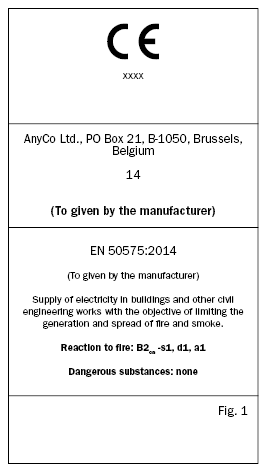
- B2ca imposes even higher requirements on flame resistance and is often the standard for public buildings with high foot traffic.

3. Strategic Goals: Sustainability and Innovation
The BauPVO is today much more than just a fire protection standard. It is a tool of the EU to achieve climate goals:
- Waste reduction: Improved material specifications aim to reduce construction waste by 10 to 15%.
- Circularity: The regulation promotes innovative construction techniques that enable easier deconstruction and recycling of hardware components.
- Future technologies: Smart infrastructure and innovative materials are made market-ready faster by the regulation.
4. Digitalization: The Digital Product Passport (DPP)
The digitalization of the construction industry is being massively accelerated by the BauPVO. From 2026, the provision of data will be at the forefront:
- Digital product passport: Information about ingredients, performance values, and the CO2 footprint must in the future be retrievable via QR code directly on the product.
- Transparency: This facilitates documentation for IT resellers and provides customers with the assurance that the installed components meet the latest standards.
What should you, as an IT reseller, pay special attention to?
✓ Declaration of Performance (DoP)
Make sure that a DoP is available for every sold installation cable (copper/fiber optic).
✓ CE Marking
Check whether the CE marking on the packaging or the cable drum label indicates the correct Euro class.
✓ Liability for Imports
If you source cables from outside the EU, you legally assume the role of the manufacturer and are liable for the accuracy of the fire protection certificates.
✓ Customer Advice
Assist your customers in choosing the right class (e.g., Cca for schools or hospitals) to avoid planning errors.